
ICE OR HEAT? WHAT THE LATEST RESEARCH SHOWS
/
For decades, the advice seemed simple: Twist your ankle? Ice it. Pull a muscle? Ice it. Throw your back out? Ice it. In fact, many of us grew up hearing the acronym RICE — Rest, Ice, Compression, Elevation — for virtually every injury.
But recent scientific evidence yields guidance that is much more nuanced than the old "ice everything" approach. Let's take a look.
Where does ice fit in?
Ice remains a great way to temporarily reduce pain after an acute injury. It helps by:
slowing pain signals
decreasing muscle spasm
limiting excessive swelling
making the injured area more comfortable
What it doesn't do is dramatically speed healing. That's one of the biggest shifts in current sports medicine research. Recent reviews suggest that the strongest benefit of ice is pain relief—not faster tissue repair.
When should you use ice?
Ice is usually most helpful during the first 24–48 hours after an injury like:
an ankle sprain
a muscle strain
a bruise
a painful ligament injury
Think of it as a way to make the injury more manageable—not as the treatment itself.
A good rule of thumb is 10–15 minutes at a time, allowing the skin to return to normal temperature before icing again.
More isn't better. In fact, very long icing sessions can irritate nerves or even damage skin.
When is heat the better option?
Heat shines in a different way. Instead of calming things down, heat encourages circulation and helps muscles relax. If you've ever stepped into a hot shower after waking up with a stiff neck, you've experienced this firsthand.
Heat is often the better choice for:
muscle tightness
chronic back pain
neck stiffness
arthritis
old injuries that simply feel "tight"
Many people also benefit from using heat before stretching or exercising because warm muscles generally move more comfortably.
Similar to ice, you only want to use heat for 15-20 minutes at a time, with ~ 20 minute breaks in between.
When should you avoid heat?
Heat isn't ideal immediately after a fresh injury.
If you've just rolled your ankle and it's swelling by the minute, adding heat may increase blood flow enough to make swelling worse.
As a general rule, avoid heat if the area is:
freshly injured
noticeably swollen
bruised
warm to the touch
Once the acute inflammatory phase settles down—often after a couple of days—heat frequently becomes much more helpful.
What about back pain?
This one is nuanced. If your lower back "went out" after lifting something heavy, there isn't one universally correct answer.
If the muscles are going into spasm, heat often provides tremendous relief.
If the injury just happened and everything feels inflamed, brief icing may feel better initially.
For many patients, the simplest advice is this: use the one that helps you move more comfortably.
Movement—not lying perfectly still—is often one of the most important parts of recovery.
The new approach: PEACE & LOVE
Sports medicine has gradually moved away from simply trying to eliminate inflammation. Many clinicians now follow what's called the PEACE & LOVE approach.
Rather than focusing only on ice, the emphasis is on protecting the injury initially, followed by gradual movement, exercise, and returning to normal activity as the body heals.
PEACE (immediately after injury)
P – Protect
E – Elevate
A – Avoid excessive anti-inflammatory strategies
C – Compress
E – Educate
LOVE (after the first few days)
L – Load (gradually)
O – Optimism
V – Vascularization (gentle cardiovascular exercise)
E – Exercise
The key message is that movement, gradual loading, education, and active rehabilitation appear to have a greater influence on long-term recovery than simply icing an injury.
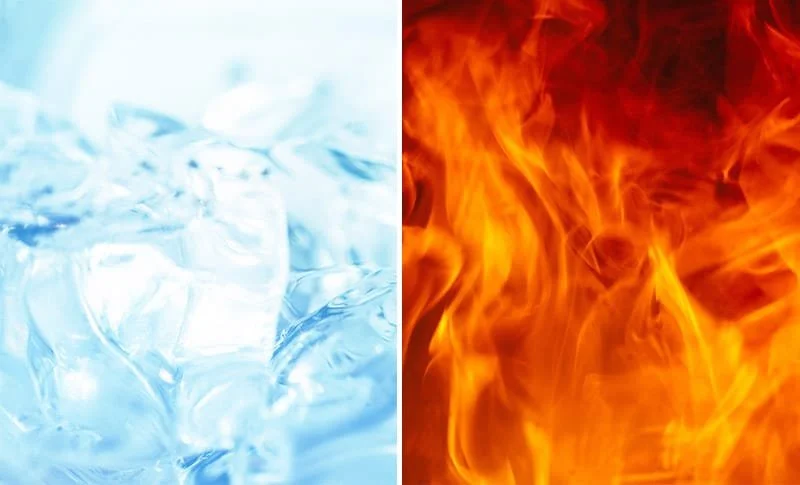
Ice vs. Heat: A Simple Decision Guide
Choose Ice If...
• The injury just happened
• Swelling is significant
• There is bruising
• Pain is severe
• You need temporary pain relief
Choose Heat If...
• Muscles feel tight
• You have chronic stiffness
• The injury is several days old
• You're preparing to stretch or exercise
• Muscle spasm is limiting movement
If you're ever unsure which approach is right—or your pain isn't improving after several days—don't hesitate to schedule an appointment. Sometimes the quickest path back to feeling your best starts with a proper evaluation, and a personalized treatment plan, including acupuncture and massage.
References
Dubois B, Esculier JF. Soft-tissue injuries simply need PEACE and LOVE. British Journal of Sports Medicine. 2020.
Racinais S, et al. Cryotherapy for treating soft tissue injuries in sports medicine. British Journal of Sports Medicine. 2024.
Wang ZR, et al. Is it time to put traditional cold therapy in rehabilitation of soft tissue injuries? World Journal of Clinical Cases. 2021.